Nevis IBC Incorporation: What Professionals and Clients Need to Know
25 October 2026

Incorporating a Nevis International Business Corporation (IBC) takes two steps: engage a licensed Trust and Corporate Service Provider (TCSP) in Nevis, then file Articles of Incorporation with the Registrar. The company’s directors and shareholders can be of any nationality and live anywhere. An IBC that does no business in St Kitts and Nevis pays no local tax on income or assets held outside it. Creditors also face a bond requirement before they can sue.
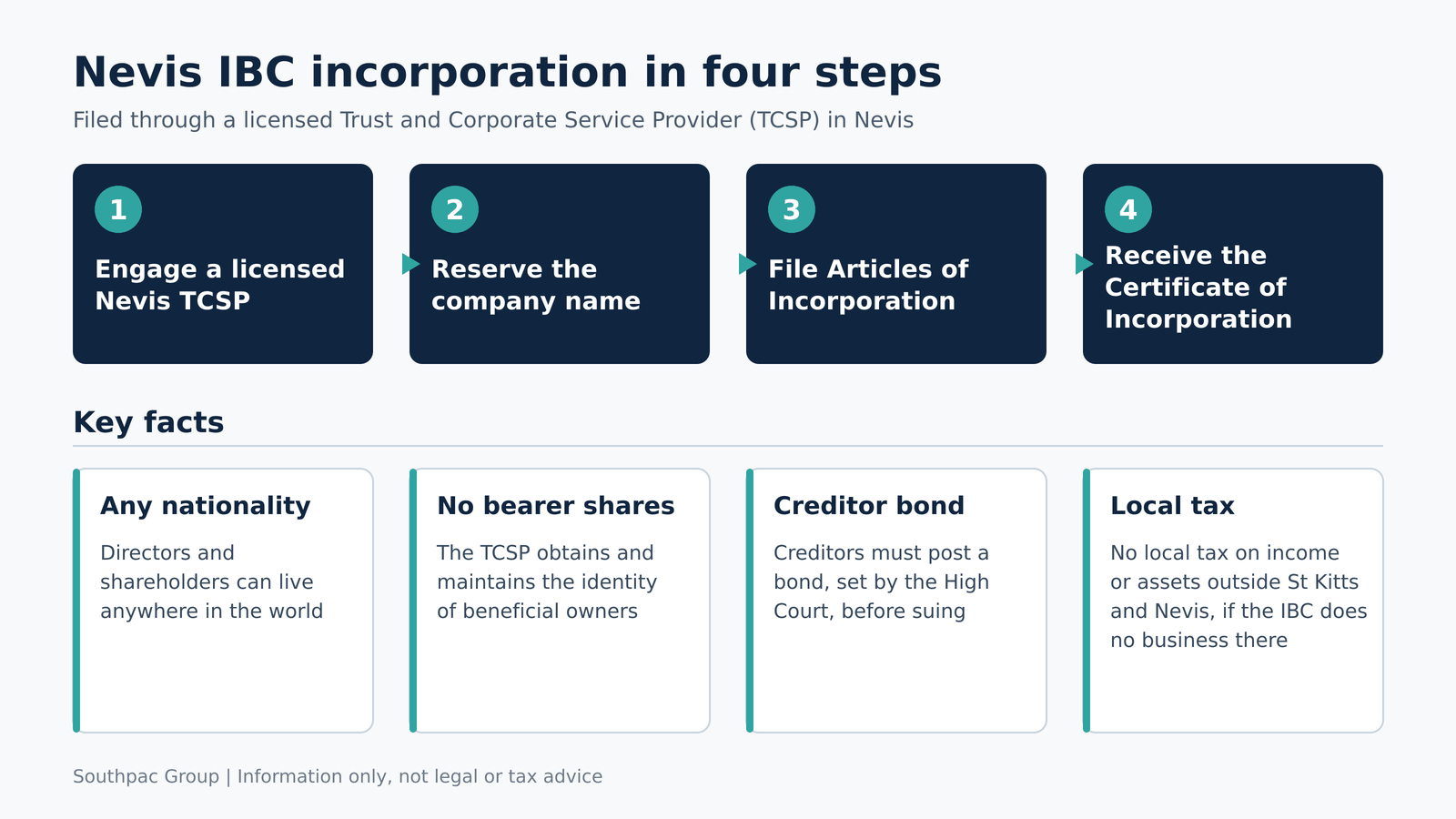
How Nevis IBC incorporation works
A Nevis IBC is a corporation registered under the Nevis Business Corporation Ordinance (NBCO). It can be formed to conduct any lawful business.
You cannot file directly. You must first engage a TCSP that is licensed by the Nevis Island Administration and has a registered office in Nevis. That office becomes the registered office of your corporation.
The process runs in four steps:
- Submit your preferred company name to the TCSP.
- The TCSP reserves the name through the Nevis Online Registration Portal (the Corporate Registry Integrated Secure System, or CRISS) or by contacting the Corporate Registry directly.
- The TCSP files Articles of Incorporation with the Registrar of Corporations.
- If the documents comply with the NBCO, a Certificate of Incorporation and/or an Endorsement Certificate is issued.
Who can own and run a Nevis IBC
Before a creditor can start legal action against a Nevis corporation, the NBCO requires them to post a bond. The High Court sets the amount, and the bond must come from a financial institution in Nevis. It covers costs the creditor may have to pay.
For your client, this adds a financial hurdle for anyone considering a weak or speculative claim. Nevis IBCs share some of the asset protection features found in Nevis trusts and limited liability companies.
Tax treatment for a Nevis IBC
An IBC that does no business in St Kitts and Nevis is not subject to local taxes on assets or income outside St Kitts and Nevis.
Each year, the directors file a simplified tax return (CIT-101) with the St Kitts and Nevis Inland Revenue Department. It declares the company’s tax residence, based on where effective management and control are exercised.
Your client’s home-country tax obligations are a separate matter. They should be reviewed with a tax professional in the relevant jurisdiction.
How a Nevis IBC protects assets from creditors
Before a creditor can start legal action against a Nevis corporation, the NBCO requires them to post a bond. The High Court sets the amount, and the bond must come from a financial institution in Nevis. It covers costs the creditor may have to pay.
For your client, this adds a financial hurdle for anyone considering a weak or speculative claim. Nevis IBCs share some of the asset protection features found in Nevis trusts and limited liability companies.
Tax treatment for a Nevis IBC
An IBC that does no business in St Kitts and Nevis is not subject to local taxes on assets or income outside St Kitts and Nevis.
Each year, the directors file a simplified tax return (CIT-101) with the St Kitts and Nevis Inland Revenue Department. It declares the company’s tax residence, based on where effective management and control are exercised.
Your client’s home-country tax obligations are a separate matter. They should be reviewed with a tax professional in the relevant jurisdiction.
Privacy, records and compliance
Nevis balances privacy with regulation. For you and your client, that means the structure is credible with banks and counterparties.
- Bearer shares are not permitted.
- The TCSP must obtain and maintain the identity of beneficial owners and shareholders.
- Any change in beneficial owners, shareholders, directors or officers must be reflected in the TCSP’s records, as required by the NBCO and the Anti-Money Laundering and Counter-Terrorism Financing (AML/CFT) Regulations.
- The TCSP and the Nevis Financial Services Regulatory Commission (Nevis Branch) must be able to access corporate and accounting records on request.
- The Commission conducts on-site examinations to check that TCSPs comply.
Flexibility after incorporation
A Nevis IBC can change as your client’s needs change:
- Amend its Articles of Incorporation, merge or consolidate with foreign or other Nevis corporations, or file Articles of Dissolution.
- Re-domicile into or out of Nevis.
- Convert from a Nevis Limited Liability Company into a corporation through a simple conversion procedure.
- Receive an emergency transfer of domicile from another jurisdiction, with approval from the Registrar of Corporations.
- Register written charges with the Registrar of Corporations.
Using an IBC alongside insurance
We do not advocate cancelling insurance. Liability coverage is an essential tool for cash flow management and legal defense costs. An offshore structure adds a second line of defense if policy limits are exceeded or coverage is denied. Southpac has spent over 40 years helping clients build these secondary lines of defense.
Frequently asked questions
What is a Nevis IBC?
It is a corporation registered under the Nevis Business Corporation Ordinance. It can be incorporated to conduct any lawful business.
Do I need a local provider to incorporate?
Yes. You must engage a TCSP licensed by the Nevis Island Administration with a registered office in Nevis. Its office serves as the corporation’s registered office.
Can directors and shareholders live outside Nevis?
Yes. Shareholders, officers and directors can be of any nationality and live anywhere. Corporations can also act as directors.
Does a Nevis IBC pay tax in Nevis?
Not if it does no business in St Kitts and Nevis. In that case it is not subject to local taxes on assets or income outside St Kitts and Nevis. Directors still file a simplified annual return (CIT-101).
Are bearer shares allowed?
No. The TCSP must obtain and maintain the identity of beneficial owners and shareholders.
What must a creditor do before suing a Nevis IBC?
The creditor must first deposit a bond with the Permanent Secretary in the Ministry of Finance. The bond is set by the High Court and issued by a financial institution in Nevis. It covers costs the creditor may have to pay.
Build the right structure with Southpac
Southpac was established in 1982 and was the first licensed trustee company in the Cook Islands. We have established more than 4,000 trusts, with no US nexus, and have teams on the ground in New Zealand, the Cook Islands and Nevis. We work with clients in 50+ countries.
If you are an attorney or advisor: Over 30 years, 100+ attorney and advisor partners have worked alongside us. They bring the client relationship and we bring the offshore structuring, so your clients get a well-built plan and you keep the lead role. [Explore partnering with Southpac]
If you are researching for yourself: Share this article with your attorney or wealth advisor so they can review the options with you. If you don’t have one, we can connect you with an experienced professional. [Contact us]
This article is for information purposes only and is not legal or tax advice. If you plan to establish or place assets into an offshore structure, consult legal and tax professionals in your jurisdiction(s) of tax residence.