Nevis Asset Protection: The Advantages of a Nevis Trust
23 October 2026

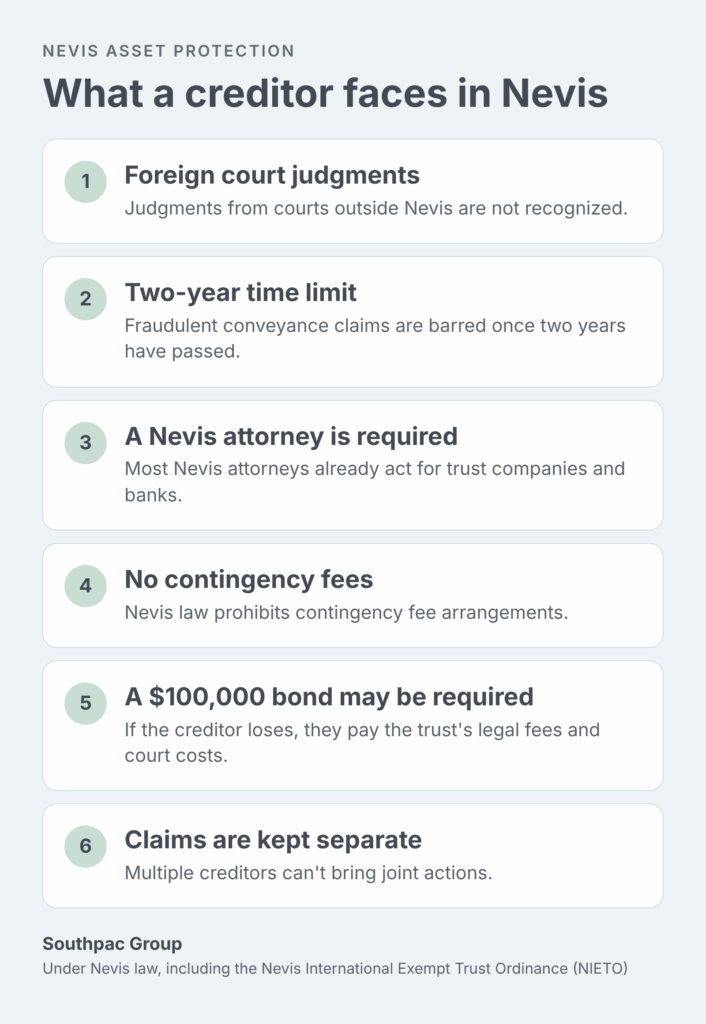
A Nevis trust is designed to make a creditor’s job as hard as possible. Foreign court judgments are not recognized, fraudulent transfer claims expire after two years, and any creditor needs a Nevis attorney and may have to post a $100,000 bond. Here is how Nevis asset protection works, whether you are protecting your own assets or advising a client.
The protection comes from the Nevis International Exempt Trust Ordinance (NIETO), introduced in 1994 and strengthened by amendments in 2015. This article covers its key protective features and how a Nevis trust works for asset protection, estate planning, and confidentiality.
How Nevis Asset Protection Works
The primary advantage of a Nevis trust is its asset protection. Several features work together:
- Foreign judgments are not recognized. A creditor cannot simply enforce a foreign court judgment against trust assets.
- Two-year limit. Nevis law sets a strict two-year statute of limitations on claims of fraudulent conveyance. After that, creditors are legally barred from pursuing litigation to reach the trust’s assets.
- A local attorney is required. Any creditor must retain an attorney in Nevis. That is not straightforward, because most Nevis attorneys already represent trust companies and banks.
- No contingency fees. Nevis law prohibits contingency fee arrangements.
- A bond may be required. The Nevis High Court may require the creditor to post a $100,000 bond before starting a claim. If the creditor is unsuccessful, they must pay the trust’s legal fees and court costs.
- Creditor claims are kept separate. Multiple creditors cannot bring joint actions. Even if a fraudulent transfer is proven, it does not invalidate the trust.
For married couples, NIETO allows property held as tenants by the entirety (TBE) and contributed to an international trust to keep its TBE treatment. In many jurisdictions, TBE ownership prevents the creditors of only one spouse from attaching to the property.
Privacy and Confidentiality
A Nevis trust must be registered in Nevis, but details of the trust, including settlor and beneficiary information, are not disclosed. Nevis has no ultimate beneficial owner (UBO) register. The registry can be searched for the status of an international business corporation (IBC) or a limited liability company (LLC), but not for a Nevis trust.
Nevis also has a law specifically to protect client information. The Confidential Relationships Act makes it a criminal offense to disclose confidential information of a business or professional nature, including information about Nevis trusts.
The Role of the Protector
NIETO allows for the appointment of a Protector, whose job is to oversee the operations of the international trust and make sure its purpose is carried out. A recent amendment clarifies that the Protector has authority to direct or approve actions of the trustee, such as making distributions or choosing specific investments.
The law also protects trustees. They are not liable for following the Protector’s directions unless they engage in willful misconduct.
Governing Law and Private Proceedings
The “proper law” of an international trust is the law of the jurisdiction named in the trust’s terms. If the terms don’t name one, the law of the jurisdiction most closely connected to the trust when it was created applies. If neither applies, Nevis law governs the trust.
The Registered Agent that registers the trust must keep accurate, up-to-date information about the trust’s customers, including the beneficial owners. This covers the settlor, trustees, protectors, and beneficiaries.
The Ordinance also provides that all non-criminal legal proceedings related to the international trust are held privately (in camera), and no information can be published without the Court’s approval.
About Nevis
Nevis is part of the federal constitutional monarchy of St. Kitts and Nevis, with two spheres of government: the federal government and the Nevis Island administration. Nevis (Oualie, “the land of beautiful waters”) is one of the most pristine and tranquil islands in the Caribbean.
It is also the birthplace of Alexander Hamilton, who served as the first Secretary of the Treasury of the United States from 1789 to 1795 during George Washington’s presidency.
Nevis Asset Protection: Frequently Asked Questions
Does Nevis recognize foreign court judgments?
No. Nevis does not recognize judgments from foreign courts, which adds a layer of security for trust assets. A creditor cannot simply enforce a foreign judgment against a Nevis trust.
How long do creditors have to challenge a transfer to a Nevis trust?
Two years. Nevis law sets a strict two-year statute of limitations on claims of fraudulent conveyance. Once it has passed, creditors are legally barred from pursuing litigation to reach the trust’s assets.
What does a creditor need to bring a claim in Nevis?
A Nevis attorney, which is difficult to find because most Nevis attorneys represent trust companies and banks. Contingency fee arrangements are prohibited, and the Nevis High Court may require a $100,000 bond before a claim begins. A creditor who loses pays the trust’s legal fees and court costs.
Is a Nevis trust private?
Yes. A Nevis trust must be registered, but details of the trust, including settlor and beneficiary information, are not disclosed. Nevis has no UBO register, no searches can be conducted on a Nevis trust, and disclosing confidential information is a criminal offense under the Confidential Relationships Act.
Can married couples keep tenancy by the entirety protection?
Yes. NIETO allows property held as tenants by the entirety (TBE) and contributed to an international trust by a married couple to continue to be treated as TBE property.
Does a Nevis trust replace liability insurance?
No. Liability coverage remains essential for cash flow management and legal defense costs. A Nevis trust is a second line of defense: if policy limits are exceeded or coverage is denied, your assets remain secure.
A Second Line of Defense That Holds
Insurance is essential, but limits can be exceeded and claims can be denied. A Nevis trust is there for those moments. For more than 40 years, Southpac has helped clients and their advisors build that second line of defense.
For attorneys, wealth advisors, and other professionals
Your clients rely on you to see risks before they arrive. Southpac works alongside you, with three licensed in-house trustee companies, teams on the ground in Nevis, the Cook Islands, and New Zealand, and no US nexus. Explore partnering with Southpac
For individuals
If this article raised questions about your own situation, the best next step is a conversation with your attorney or wealth advisor. Share this article with them and ask them to get in touch with Southpac about whether a Nevis trust fits your circumstances. If you don’t have an advisor, we can connect you with one. Contact us.
Disclaimer: the article above is for information purposes only. It is not intended to constitute legal or tax advice. If you are planning to establish or place assets into an offshore structure, please consult beforehand with legal and tax professionals in your jurisdiction(s) of tax residence.