Can You Hold Cryptocurrency in an Offshore Trust? Yes, and There Are Three Ways to Do It
15 October 2026
This article is part of our series on Digital Asset Protection. [Protecting Cryptocurrency with an Offshore Trust] explains why crypto needs a protection strategy and how a trust and LLC work together. [Crypto and Custody] covers succession and the lost seed phrase problem.
Over the last few years, one of the questions we hear most often is whether cryptocurrency and other digital assets can sit inside a trust.
The answer is yes. This article looks at the practical side: where the assets are actually held.
In the video below, Guy Carson, our Head of Banking & Investment, walks through the options.
Control: the question every crypto holder asks first
“Not your keys, not your crypto.” Crypto’s appeal is that no one else controls your assets, while a trust involves an independent trustee. So how do the two fit together?
A trust isn’t about handing everything over and walking away. The goal is to stay informed and involved without keeping ownership-level control. Regular reporting, clear communication, a protector, and a detailed letter of wishes keep you close to what’s happening. What the structure can’t do is let you treat the assets as your own, because that would undermine the protection.
The three options below sit at different points on that spectrum. Some are more hands-off and others keep you closer to the day-to-day.
Option 1: Hold them at trust level through a regulated hybrid bank
We work with banks in a number of jurisdictions, including Switzerland, that can hold cryptocurrency and provide highly secure cold storage. The assets sit within the trust structure, held by a regulated institution.
Holding assets directly at trust level has its own trade-offs, which we cover in [Protecting Cryptocurrency with an Offshore Trust].
Option 2: Add an investment advisor
If you’d like your digital assets to do more than sit in storage, we also work with investment advisors who operate alongside these banks. They can design option and staking strategies that may generate income. This sits on top of the bank custody in Option 1.
Option 3: Hold them through a company owned by the trust
Here’s how it works:
- We establish the trust.
- We set up a company under the trust, typically an LLC.
- A manager is appointed to run the company. That could be the settlor or someone else.
- The manager either opens an account with an exchange of their choosing or holds the wallet directly and keeps physical control of the cryptocurrency.
This option suits people who want to stay close to the day-to-day handling of their digital assets. Because the trust owns the company, you don’t personally own it, and that’s what separates the assets from your personal liabilities. In Nevis and the Cook Islands, the trustee can also replace the manager if needed. Both points are explained in more detail in [Protecting Cryptocurrency with an Offshore Trust].
The three options side by side
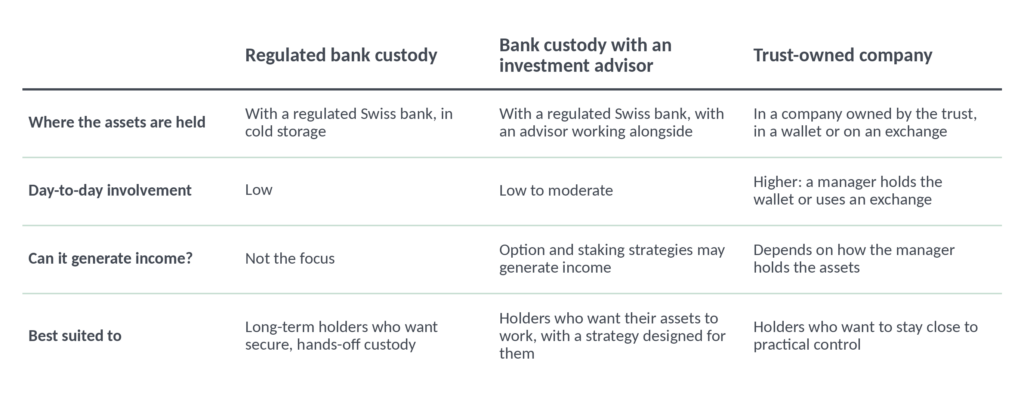
That depends on how you hold your assets today, how actively you want to manage them, and what you want the structure to do for you or your clients. Some people want secure, hands-off custody. Others want a strategy that generates income. Others want to keep hands-on access.
These options aren’t the only custody arrangements as you’ll see in [Crypto and Custody].
Common questions
Can a trust hold cryptocurrency?
Yes. Southpac has several ways of holding digital assets within a trust structure: through a bank, an investment advisor, or a company owned by the trust.
Will I still have access to my assets?
That depends on the option. With bank custody, the bank and trustee hold the assets, and you stay informed through reporting and communication. With the company option, a manager, who may be you or someone else, can hold the wallet directly or use an exchange. Either way, the aim is to keep you informed and involved, not to give you ownership-level control.
Can I use an exchange I already trust?
Under the company option, the manager can open an account with an exchange of their choosing.
Can my digital assets earn income inside a trust?
Through our investment advisor partners, option and staking strategies may generate income. Results depend on the strategy and the market, and nothing is guaranteed.
What happens to my digital assets if something happens to me?
That’s a succession question, and we cover it in [Crypto and Custody].
Who do I speak to?
Contact Southpac and we’ll look at how you hold your assets today and help you choose the right option.
Are you a wealth advisor or attorney?
If your high net worth clients hold digital assets and need asset protection, we’d like to work with you. Partner with Southpac and see how we can support you and your clients.
Keep reading in this series
- [Protecting Cryptocurrency with an Offshore Trust]: why crypto needs a protection strategy, and how a trust and LLC work together
- [Crypto and Custody]: succession, probate, and the lost seed phrase problem